


WHEN, not IF

I recently collaborated with WSJ's Gunjan Banerji on a project where she provided ChatGPT with the profile of an investor, and prompted it to suggest an appropriate portfolio. The result is this article, published earlier this week:
During the process, I kept thinking about Kasparov vs. Deep Blue.

I was a competitive chess player as a kid, and the original match took place in 1996 (when I was 12). At the time, there was serious debate about whether computers would ever consistently outplay humans at chess.
Today that sounds absurd.
Modern grandmasters rely heavily on computers for training and analysis. Computers aren't just better than humans at chess — they are unimaginably better. It was a WHEN, not IF question. Seems obvious now, but didn't then.
Bruce Weber covered the original match for the NYT, including an extremely prescient comment from computer scientist Monty Newborn:


When computers got so good, human chess players didn't disappear. They adapted. Today, human chess players rely on computers to be better human chess players.
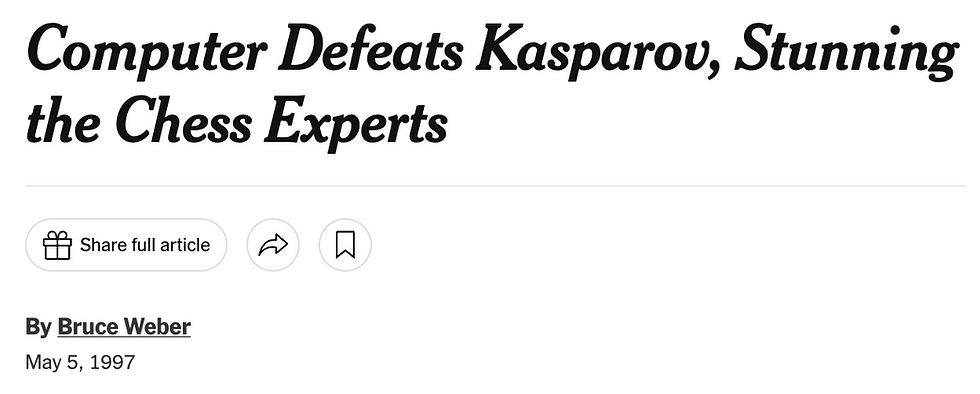
And if Kasparov was the litmus test, it happened quickly, as he lost a rematch just a year later, in 1997:
Weber's article concluded with input again from Newborn:

That's the conversation that professions need to be having: do I work in a field with clear answers, optimal solutions, or repeatable decision trees? If yes, humans are likely to matter less over time.
Technology isn't going to get less impressive. The odds are stacked against us for any activity where humans were the best available tool until machines caught up.
Some parts of where we are going are unsettling, but other parts will be fantastic.
My daughter is three years old and I don't think she'll ever drive a car. Humans are distracted, error-prone, emotional, and inconsistent. If, when she's 16, she can safely sit alone in a car and quietly read a book while technology drives, that sounds pretty good to me.
I'm not going to fight it. I'm going to get her interested in books.
That's where we're going. So what will happen to investing?
I was excited to participate in WSJ's project because it feels like a Deep Blue moment for financial advisory work. The pace of innovation is staggering: when Gunjan and I first spoke in late January, I was barely aware of Anthropic's Claude. It's now May, and I can't imagine life without it.
Is AI better than humans at designing portfolios?
Here's what ChatGPT was prompted:

And here's the portfolio it designed:

Frankly, it's better than what most advisors would come up with.
Reasonable stock/bond split.
Globally diversified.
Low-cost index funds.
Tax-awareness (even if imperfectly implemented).
It got many of the big things right. I'd say C+ / B- in that it's competent, but coarse.
But here were some of the silly, unnecessary errors/oversights:
It interpreted "growth-oriented allocation" as requiring an overweight to "growth stocks." But growth investing refers to buying relatively expensive stocks trading at high multiples, not to maximizing the expected growth of a portfolio. Historically, value stocks have outperformed growth stocks.
It overemphasized dividends in a taxable portfolio, even though dividends create unwanted taxable income distributions. Yield is for farmers.
It suggested lower-yielding municipal bonds, which can make sense for investors in high tax brackets, without knowledge of the investor's tax bracket. Portfolio size and taxable income are not the same. Critical distinction before embracing lower-yielding municipal bonds for tax purposes.
Suggested REITs in a taxable portfolio. REITs are a reasonable asset class, but distribute large amounts of income and should instead be held in IRAs or 401(k)s.
Used inflation-protected bonds in an aggressive portfolio. Inflation-protection is insurance, and insurance costs money (here, in the form of lower expected yields). Young, long-term investors with aggressive portfolios shouldn't need additional insurance for inflation. Inflation expectations are already priced into assets.
Presumed liquidity needs. That 5% in cash should be expected to drag down the portfolio over time. ChatGPT should have asked clarifying questions, like if Gunjan had money in her bank for liquidity, or what her monthly spending was to determine a reasonable emergency fund.
And notably it didn't incorporate deeper financial science beyond generic indexing. I don't think investors should pick individual stocks, but that doesn't mean that all stocks are created equal. There is compelling, empirical evidence that investors should overweight value stocks (e.g. stocks that may have similar profits to others, but trade at lower prices) and high relative profitability stocks (stocks that have similar prices to others, but make more profits).
But here's the thing: these are all solvable. Like Deep Blue, AI can get better (and probably quickly). The growth hiccup gets solved with enough training data, the municipal bond error disappears once it gets better at tax; it will eventually ask the user better questions, and deliver better outputs.
WHEN, not IF.
And frankly, good. Too much of the advisory industry still charges excessive fees for mediocre-to-slipshod investment work. I hope those firms get AI'd out. Good riddance.
A great advisory firm does many things beyond just portfolio design, and I'm not seeking job security when I say that AI just ain't there yet. I have every belief that in the not-too-distant future, it can "beat" me on this task.
As Newborn pointed out after the 1996 chess match, "We have to learn to be good friends." An advisor's job will be to determine where it's better than computers and where it's not (which will evolve through time), and act accordingly.
Per Newborn after the 1997 match, Kasparov was fatally human. But the same emotional and psychological qualities that are flaws in chess versus machines, are the same qualities that many clients hire a great advisor for: they want an empath with shared human experiences to discuss their situation with.
At Peltoma, we have always stated our value proposition simply:
We help clients make high-quality decisions and manage tradeoffs.
It's a broad description that defines a narrow part of being a time-impoverished human living in a chaotic world: life is full of competing inputs.
Time
Taxes
Expected investment returns
Family dynamics
Risk appetite
Career uncertainty
Health
Dreams
Hassle
Opportunity cost
A good advisor organizes and describes these inputs to help people make better decisions. Yes, that means knowing growth has two different definitions in finance, and the difference between "income" and "wealth" before choosing municipal bonds.
But it also means knowing family dynamics between two siblings when discussing estate planning decisions by parents, helping a client quantify the joy they'll get in giving their money away while still living as opposed to dead, or describe probabilistic scenarios which she can or can't have the retirement experience she's chasing.
THOSE ARE HARD.
Taxes aren't hard. Taxes are complex for humans.
But taxes have rules. Rules-based systems get AI'd.
Taxes. Chess. Driving. Logistics. Manufacturing.
WHEN, not IF.
And so unlike chess, as an advisor managing tradeoffs and grey areas, it's helpful to have a heartbeat. AI will be able to optimize portfolios, but it cannot participate in the human experience.
AI is just a large language model, and some words are too large:
Fear
Ambition
Grief
Greed
Love
Envy
Generosity
Regret
The opportunity here is for the next generation of advisors to embrace AI where appropriate, and double-down on being human elsewhere.
But it is coming.

Advisors can't lie to ourselves that AI won't design better portfolios; instead we need to ask what opportunities will open up to be good friends with it.
One thing is obvious: we are just getting started. What a cool time to be alive, y'all.
End.


The comparison to chess and the "WHEN, not IF" prophecy for AI in finance is incredibly compelling. It's clear AI will master portfolio design and rules-based tasks, compelling advisors to double down on empathy and complex human tradeoffs, a transformation as profound as how sz games have impacted competitive chess.